The Pentagon Is Rediscovering a 41-Year-Old Military Secret

On September 13, 1985, Air Force Major Wilbert “Doug” Pearson climbed into the cockpit of an F-15A Eagle at Edwards Air Force Base in California.
His mission was unlike anything an American fighter pilot had attempted before…
His target wasn’t another aircraft. It wasn’t an enemy warship or a missile installation.
It was a satellite orbiting hundreds of miles above Earth.
Pearson accelerated his fighter jet, pulled into a steep climb, and released a 2,600-pound missile that streaked toward space.
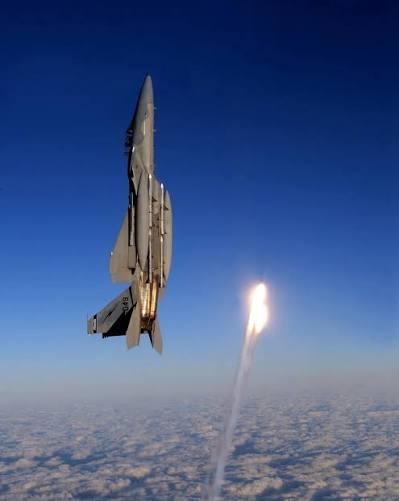
Moments later, that missile struck its target: an obsolete American research satellite called Solwind.
The satellite was disabled and the mission was deemed a success…
Originally conceived as a response to Soviet antisatellite weapons, the experiment demonstrated that an ordinary fighter jet could serve as a launch platform for a vehicle capable of reaching space.
It also demonstrated something the military would spend the next four decades struggling to perfect…
What if we could use fighter jets not to destroy satellites but to launch them?
What if America could deploy new satellites without relying on massive rockets and vulnerable launch facilities?
Forty-one years later, those questions are suddenly relevant again.
And a newly published Air Force research paper suggests that reviving this Cold War technology could become an important part of America’s national security strategy.
Interestingly, one little-known American aerospace company is already working on it.
The Space Race That Never Took Off
Following the successful 1985 interception, the United States began exploring the possibilities of airborne space launches.
The concept was relatively straightforward…
Instead of launching rockets directly from the ground, aircraft would carry them thousands of feet into the atmosphere before releasing them toward space.
This approach offered several potential advantages, including greater flexibility in launch locations, reduced atmospheric drag, and less dependence on permanent launch facilities.
In 1990, Orbital Sciences successfully launched its Pegasus rocket from a B-52 bomber, placing a satellite into orbit.
Pegasus eventually completed 45 launches, delivering more than 90 satellites into space.
And the Pentagon subsequently attempted to improve upon the concept.
In 2011, the Defense Advanced Research Projects Agency (DARPA) initiated its Airborne Launch Assist Space Access program.
Its objective was ambitious: develop the capability to launch small satellites within 24 hours for less than $1 million per mission.
Unfortunately, propulsion problems eventually killed the program.
Virgin Orbit later attempted something similar, using a modified Boeing 747 to launch satellites.
The technology worked, but the economics didn’t. Following a series of successful missions and a subsequent launch failure, Virgin Orbit filed for bankruptcy in 2023.
Pegasus was the only effort that survived, although its operations became increasingly limited.
Because the problem wasn’t necessarily the underlying technology. It was developing a commercially sustainable business around it.
And that’s a distinction that could become extremely important over the next several years.
The Best Free Investment You’ll Ever Make
Join Wealth Daily today for FREE. We’ll keep you on top of all the hottest investment ideas before they
hit Wall Street. Become a member today, and get our latest free report: “The $10 Trillion AI Infrastructure Boom.”
It contains full details on why money managers are overpaid and provides you with
tools for growing your wealth.On your own terms. No fees, no commission.
The Pentagon Has a Satellite Problem
In August, Air University Press published a fascinating research paper titled Reigniting a National Airborne Space Launch Capability.
Written by Air Force Lieutenant Colonel Ali Hamidani, the paper makes a compelling case for revisiting airborne launch.
But this time, the motivation isn’t necessarily making commercial space launches cheaper.
It’s national security.
You see, modern warfare depends heavily on satellites.
Everything from battlefield communications and GPS navigation to intelligence gathering and missile detection requires infrastructure orbiting hundreds or thousands of miles above Earth.
And unfortunately, that infrastructure is becoming increasingly vulnerable.
Both Russia and China have demonstrated weapons capable of destroying satellites.
China famously destroyed one of its own weather satellites in 2007. Russia conducted a similar test in 2021, generating more than 1,500 pieces of trackable orbital debris.
Both countries have also developed technologies capable of approaching and potentially interfering with other spacecraft.
That presents the American military with an increasingly serious problem.
What happens if an adversary disables a significant portion of America’s satellite infrastructure during a conflict?
And, perhaps more importantly, how quickly could we replace it?
That’s precisely the problem Hamidani addresses…
His argument is that America needs a resilient launch infrastructure capable of rapidly replacing damaged or destroyed satellites.
And airborne launch could provide an important piece of that infrastructure.
Just think about it…
Conventional orbital launches rely on specialized ground installations that are expensive, geographically restricted, and potentially vulnerable to enemy attacks.
An aircraft-based launch system could operate from multiple locations, making it considerably more difficult for adversaries to disrupt America’s access to space.
It could also provide flexibility when the military needs to replace a satellite without waiting for an available launchpad or a meteorological window.
In fact, Hamidani specifically proposes using the Air Force Test Pilot School and Space Test Fundamentals program at Edwards Air Force Base to develop the technology.
And here’s where things get really interesting…
The paper even discusses how the Air Force previously used specially modified F-104 Starfighters to conduct experimental flights above 100,000 feet.
And that particular aircraft should sound familiar to investors following the emerging space economy.
Because one small American company happens to operate an entire fleet of them.
Meet the Company Bringing Cold War Technology Back to Life
Starfighters Space (NYSE: FJET) isn’t your typical aerospace startup.
Rather than spending billions developing new aircraft, the company operates a fleet of supersonic F-104 Starfighters.
Based at NASA’s Kennedy Space Center, these aircraft can exceed Mach 2 and carry payloads to approximately 45,000 feet.
And Starfighters is developing technology that could transform those legendary Cold War fighters into reusable airborne launch platforms.
Its STARLAUNCH program is designed to use the F-104 as the first stage of a launch system, carrying specialized rockets high into the atmosphere before releasing them.
The company’s initial STARLAUNCH 1 vehicle is designed for suborbital missions, while its planned STARLAUNCH 2 system targets orbital satellite deployment.
Importantly, Starfighters isn’t starting from scratch.
It already operates supersonic aircraft and provides aerospace testing services to established defense and aerospace customers.
It has also spent considerable time developing the technology required for airborne launch.
In January, the company announced that STARLAUNCH 1 had successfully completed wind tunnel separation testing at both subsonic and supersonic speeds.
Its engineering efforts have involved GE Aerospace, and its existing customers include Lockheed Martin and the Air Force Research Laboratory.
More recently, Starfighters announced agreements involving payload processing and rocket propulsion development, adding capabilities that could support future launch missions.
Now, none of this means Starfighters has perfected orbital launch, because it hasn’t.
Nor has the Pentagon announced that Starfighters will lead the national capability envisioned in Hamidani’s paper.
But the company already possesses operational aircraft, experienced personnel, established defense-industry relationships, and an active development program.
Those assets could make it a potential participant in future military airborne-launch initiatives.
And that’s particularly interesting considering the economic argument at the heart of Hamidani’s research.
The Next Military Space Opportunity
One of the paper’s most important conclusions is that the commercial market alone might never sustain a robust airborne-launch industry.
Traditional rocket launches have become increasingly affordable, making it difficult for specialized systems to compete strictly on price.
But the Pentagon has requirements that commercial launch customers don’t necessarily share.
When national security depends on replacing a critical satellite immediately, the cheapest available rocket might not be the appropriate solution.
And for companies developing the necessary technology, sustained government funding could create an important new market.
Starfighters’ existing capabilities position it to pursue opportunities in aircraft-based testing and potentially in the development of responsive launch systems.
Of course, development delays, technical setbacks, and additional capital requirements remain significant risks.
Nevertheless, the strategic need identified in this new research paper is clear…
America needs more than the ability to put satellites into orbit. It needs ways to replace them quickly, reliably, and under potentially hostile conditions.
And the technology that could help accomplish that mission has been around for more than four decades.
What America needs now is a practical way to deploy it.
Starfighters Space is among the companies working to make that possible.
But it’s far from the only little-known company helping build America’s next-generation military space infrastructure.
In fact, an entire network of smaller aerospace companies is developing the specialized technologies necessary to support American operations in space.
We’re talking about companies supplying the infrastructure, advanced technology, and specialized capabilities needed to expand America’s military presence beyond Earth.
And some remain virtually unknown to mainstream investors.
We’ve identified several of these companies in our latest special research report, including businesses helping build upon the foundation SpaceX has already established.
And I recommend you discover the little-known companies developing America’s next generation of military space capabilities before they finish developing them.
To your wealth,

Jason Williams
 @TheReal_JayDubs
 Angel Research on Youtube
After graduating Cum Laude in finance and economics, Jason designed and analyzed complex projects for the U.S. Army. He made the jump to the private sector as an investment banking analyst at Morgan Stanley, where he eventually led his own team responsible for billions of dollars in daily trading. Jason left Wall Street to found his own investment office and now shares the strategies he used and the network he built with you. Jason is the founder of Main Street Ventures, a pre-IPO investment newsletter; the founder of Future Giants, a nano cap investing service; and authors The Wealth Advisory income stock newsletter. He is also the managing editor of Wealth Daily. To learn more about Jason, click here.
Want to hear more from Jason? Sign up to receive emails directly from him ranging from market commentaries to opportunities that he has his eye on.
The Best Free Investment You'll Ever Make
We never spam! View our Privacy Policy
After getting your report, you’ll begin receiving the Wealth Daily e-Letter, delivered to your inbox daily.
Angel Publishing Investor Club Discord - Chat Now
Jason Williams Premium
Introductory

Advanced


